Saturday, April 16, 2011

Teaching Robots

Designed To Interact Better With Humans
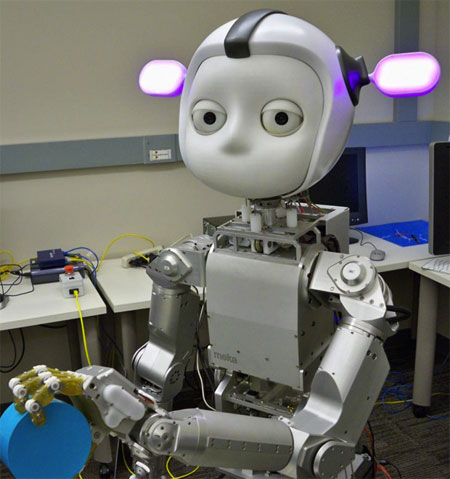

The 6th annual ACM/IEEE Conference on Human-Robot Interaction just ended in Switzerland this week and Georgia Tech is excited to share three of their presentations showcasing the latest research in how humans and robots relate to each other .
Robots Get Our Attention


Humans rely on lots of fairly abstract social conventions when we communicate, and most of
them are things that we don't even think about, like gaze direction and body orientation. Georgia Tech is using their robot, Simon, to not just try to interact with humans in the same ways that humans interact with each other, but also to figure out how to tell when a human is 
directing one of these abstract social conventions at the robot.
People Respond to Being Touched by a Robot


Teaching Robots to Move Like Humans


Affetto Japanese Baby Robot

Uncanny Baby via YouTube

This robot head, which is supposed to represent a 1 to 2year-old child, is meant to help researchers study caregiver-child interactions. It is not meant to make you run screaming from a room.

Hisashi Ishihara, Yuichiro Yoshikawa, and Prof. Minoru Asada of Osaka University in Japan have been working on robots to study cognitive development. They say it’s hard for humans to interact with robots in a natural way, so they wanted to create a robot that can mimic the facial expressions of a real kid.

Asada’s team came up with Affetto, which can produce a wide range of facial expressions by moving actuators in its face. It can look inquisitive, happy, surprised, upset and more, by tilting its eyebrows, moving its jaw, panning its eyes and tilting its head. Its eyeballs are equipped with cameras and it has microphones and tactile sensors embedded in its silicone skin, lending it a pretty realistic appearance.

Affetto is part of a project to develop a full-bodied robot that's as similar to a human being as possible, reports IEEE.